

Commercial Waterproofing in NYC: Complete Guide
Water does not announce itself in a NYC commercial building. It works quietly behind a plaza deck or inside a foundation wall for months before anyone notices a stain. Commercial waterproofing stops that process before it starts, and in a city built on dense construction and buildings sitting directly against groundwater, it’s structural protection, not optional maintenance.
At Malatesta Paladino, we’ve protected NYC commercial properties from water infiltration since 1985, and waterproofing failures are one of the most common reasons we get called to a NYC building. This guide walks through the systems and decisions behind a properly waterproofed building.
- Commercial waterproofing protects concrete, steel reinforcement, and occupied space from water infiltration
- NYC’s aging buildings, freeze-thaw cycles, and high groundwater make waterproofing a structural priority, not cosmetic upkeep
- Sheet, liquid, hot-applied, modified bitumen, and crystalline systems each suit different applications
- Below-grade walls, plaza decks, parking garages, rooftops, sidewalk vaults, and facade joints all need different waterproofing approaches
- Traffic-bearing membranes protect parking decks and plazas that carry vehicle or heavy foot traffic
- Cost depends on area, substrate condition, access, and whether it’s new construction or an existing-building repair
What Is Commercial Waterproofing and Why Does It Matter?
Commercial waterproofing is the system of materials and methods that keep water out of a building’s structure, whether from rain, groundwater, or runoff. It’s not a single product, it’s a designed system matched to the water source, meant to perform for decades. Treating it as an afterthought is one of the costliest mistakes a commercial owner can make.
How Commercial Waterproofing Protects Buildings
- Prevents water infiltration into occupied and below-grade spaces
- Protects structural concrete and embedded steel reinforcement from corrosion
- Reduces moisture-related deterioration of masonry, concrete, and finishes
- Keeps underground spaces, basements, and vaults dry and usable
- Extends the useful life of roofs, decks, facades, and structural components
Commercial Waterproofing vs. Residential Waterproofing
A homeowner with a damp basement and a property manager running a 20-story commercial tower aren’t solving the same problem. Commercial buildings carry far more structural complexity, more exposure to groundwater pressure, and often surfaces that have to hold up under vehicle traffic rather than just foot traffic.
- Building size and structural complexity are significantly greater on commercial properties
- Commercial buildings face more groundwater exposure and hydrostatic pressure, especially with multiple below-grade levels
- Traffic-bearing surfaces, like parking decks and loading areas, need specialized membrane systems residential work never requires
- Occupancy and operational continuity matter, since a commercial building can’t simply close for repairs
- Project coordination and safety requirements scale up considerably on an active commercial site
What Happens When a Commercial Building Has Poor Waterproofing?
Poor or failed waterproofing rarely stays a small problem. Once water finds a path into a structure, it keeps finding new paths, and a hairline crack or worn sealant joint can escalate into a six-figure structural repair within a few years.
- Concrete spalling and cracking as water cycles through freeze-thaw conditions
- Corrosion of embedded reinforcing steel, which expands and cracks the surrounding concrete
- Water damage to basements, below-grade mechanical rooms, and occupied underground spaces
- Deteriorating expansion joints and sealants that widen the entry points for more water
- Progressive damage to parking structures and plaza decks under constant traffic and salt exposure
Why Commercial Waterproofing Is Particularly Important in NYC
NYC is a uniquely demanding environment for any building envelope. Between the age of its building stock, construction density, below-grade square footage, and swinging seasons, water has more chances to find its way in here than almost anywhere else.
Aging Commercial Buildings and Deteriorating Building Materials
A large share of NYC’s commercial stock predates modern waterproofing standards entirely. Concrete, masonry, and original envelope components all lose performance over decades, and many buildings have already gone through partial repairs that were never integrated into one coherent system.
Heavy Rainfall, Snow and Freeze-Thaw Cycles
New York City’s seasonal swings accelerate existing damage. Water that gets into a crack during a fall rainstorm doesn’t just sit there, it expands as it freezes over winter, and that expansion is what physically pries concrete and masonry apart from the inside.
High-Rise Buildings and Complex Building Foundations
Manhattan’s high-rises often sit on multi-level foundations with underground parking, mechanical rooms, and storage extending well below street level. Protecting that much below-grade square footage requires detailing a simpler, shallow foundation would never need.
Much of Manhattan sits on a naturally high water table, which means below-grade walls on many commercial properties face hydrostatic pressure year-round, not just during storms.
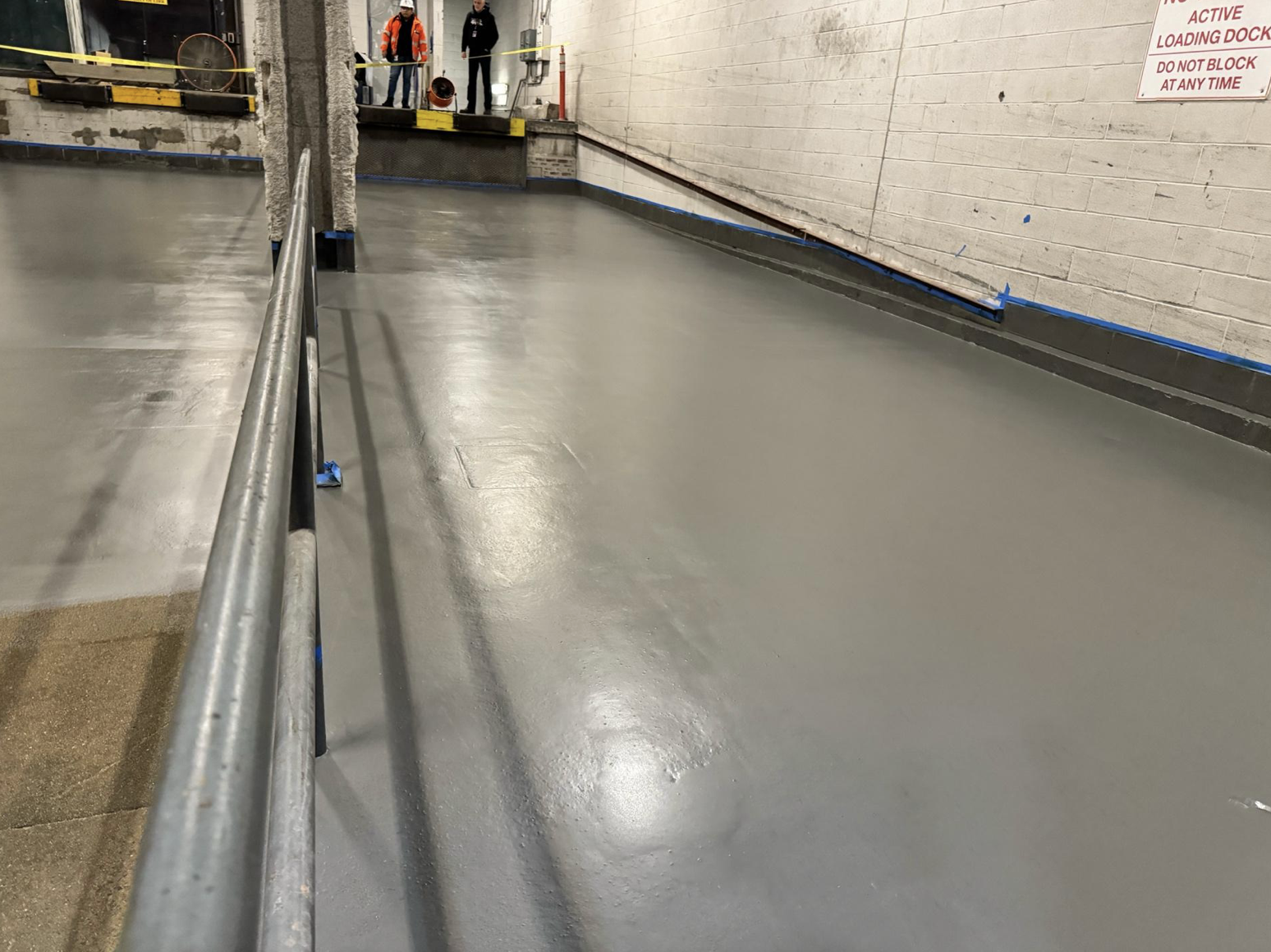
Below-grade waterproofing is where NYC’s geography creates the most pressure, literally. Much of the island sits on a high water table, so basements and foundation walls face constant hydrostatic pressure from groundwater. The system has to perform continuously, not just resist the occasional heavy rain.
- Hydrostatic pressure pushes water into any gap in the waterproofing system
- Below-grade systems need continuous membrane coverage, not spot repairs
- Foundation wall detailing around penetrations and corners is where failures usually start
Working Around Occupied Commercial Properties
Unlike new construction, most waterproofing work on NYC commercial buildings happens while the building is still operating. Access restrictions, tenant safety, and scheduling become part of the project itself, not an afterthought.
Different Types of Commercial Waterproofing Systems
There’s no single waterproofing product that works everywhere on a building. The right system depends on the surface, the exposure, and whether it carries traffic. Here are the systems we actually install on NYC commercial properties, not a generic product list.
Sheet-Applied Waterproofing Membranes
Sheet membranes, like Grace Bituthene 3000, are factory-manufactured rolls applied to a prepared substrate, giving consistent thickness that’s harder to achieve with field-mixed materials.
- Manufactured under controlled conditions for consistent thickness and performance
- Installed by rolling and adhering sheets to a clean, primed substrate
- Common on below-grade foundation walls and footings
- Seams and terminations need careful detailing, since that’s where failures tend to start
Liquid-Applied Waterproofing Systems
Liquid-applied systems, like Laurenco cold-applied waterproofing, go on as a fluid and cure into a seamless membrane, well-suited to complex geometry where a sheet product would need excessive seaming.
- Creates a continuous, seamless barrier with no joint lines
- Conforms to irregular surfaces, corners, and penetrations
- Suitable for complex substrates where sheet membranes would require extensive detailing
- Cure time and surface preparation directly affect long-term performance
Hot-Applied Rubberized Asphalt Waterproofing
Hot-applied systems, like Hydrotech rubberized asphalt, are heated to a fluid state and applied to the substrate, cooling into a thick, fully adhered membrane. This is the system most commonly specified under NYC plaza and podium decks.
- Applied hot and fully bonds to the substrate as it cools
- Builds a thick, durable membrane well suited to plaza and podium decks
- Requires a protection course and proper surface preparation during installation
Modified Bitumen Waterproofing Systems
SBS modified bitumen systems, like Siplast, use multiple reinforced layers to build redundancy in, so a single point of damage doesn’t mean a system-wide failure.
- Multi-layer, reinforced membrane construction
- Adds redundancy that single-layer systems don’t have
- Common on roofs, plazas, and large horizontal concrete surfaces
Crystalline Waterproofing
Crystalline waterproofing works differently. It’s mixed into or applied onto concrete, where it reacts with moisture to grow crystals that fill the pore structure, blocking water from inside the material itself.
- Becomes part of the concrete rather than sitting on top of it
- Well suited to below-grade concrete walls and slabs
- Depends on substrate quality and isn’t a substitute for proper concrete repair
Positive-Side vs. Negative-Side Waterproofing
This distinction matters more than most owners realize: it determines whether waterproofing stops water before it reaches the structure, or just manages water that’s already in.
Positive-side waterproofing is the industry-preferred approach whenever excavation or exterior access is possible, since it keeps water from ever reaching the structure instead of just managing it after the fact.
- Positive-side waterproofing is installed on the water-facing side of the structure, stopping intrusion before it starts
- Negative-side waterproofing is applied on the interior, dry side, usually when the exterior isn’t accessible
- Positive-side is generally the stronger long-term approach when access allows for it
- Negative-side systems are often used on existing buildings where excavation isn’t practical
Commercial Waterproofing Applications in NYC Buildings
Every area of a commercial building has a different relationship with water, which is why a one-size-fits-all approach doesn’t hold up. Here’s how these systems actually get applied across a typical NYC commercial property.
Below-Grade and Foundation Waterproofing
Foundation walls, basements, and underground structures sit directly against soil and groundwater, making this area the most exposed to constant hydrostatic pressure and the least forgiving of shortcuts.
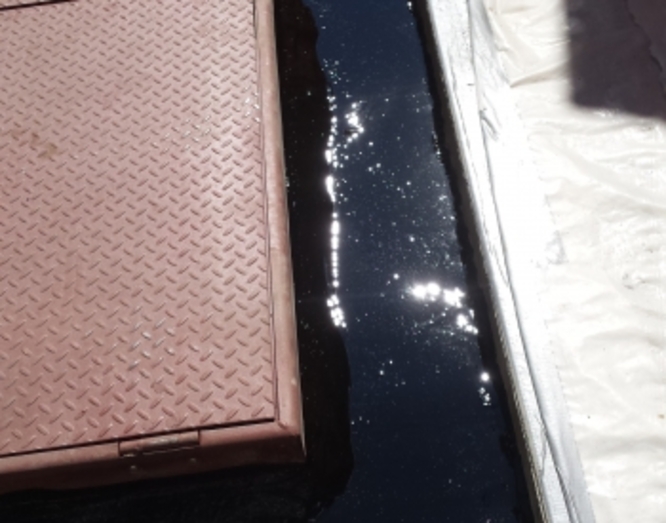
Plaza decks sit over occupied space, so a failure here doesn’t just damage the deck, it leaks into the lobby, garage, or retail space below. These decks also carry pedestrian traffic, planters, and pavers, so the membrane has to handle structural loading on top of weather exposure.
- Membrane continuity across the full deck is critical, since one weak seam can leak well beyond its own footprint
- Drainage design matters as much as the membrane itself
- Protection boards and wear courses shield the membrane from the traffic above it
Parking structures combine three of the harshest conditions a waterproofing system can face: constant vehicle traffic, standing water, and de-icing salts that accelerate corrosion of the reinforcing steel. We cover this in more depth in our guide on parking garage repairs under Local Law 126.
- Vehicle traffic demands abrasion-resistant, traffic-bearing membrane systems, not standard waterproofing
- Chloride-laden water from de-icing salts is one of the leading causes of reinforcing steel corrosion
- Ramps and turning areas see the heaviest wear and often need reinforced detailing
Rooftop Terrace Waterproofing
Rooftop terraces combine full weather exposure with regular foot traffic, so the membrane underneath needs both weatherproofing performance and a durable wear surface to protect it long-term.
Sidewalk Vault Waterproofing
Many NYC commercial buildings have underground vault space beneath the public sidewalk, and waterproofing it is a specific scope overlapping with structural sidewalk work. See our guide on vaulted sidewalk repair and structural reinforcing.
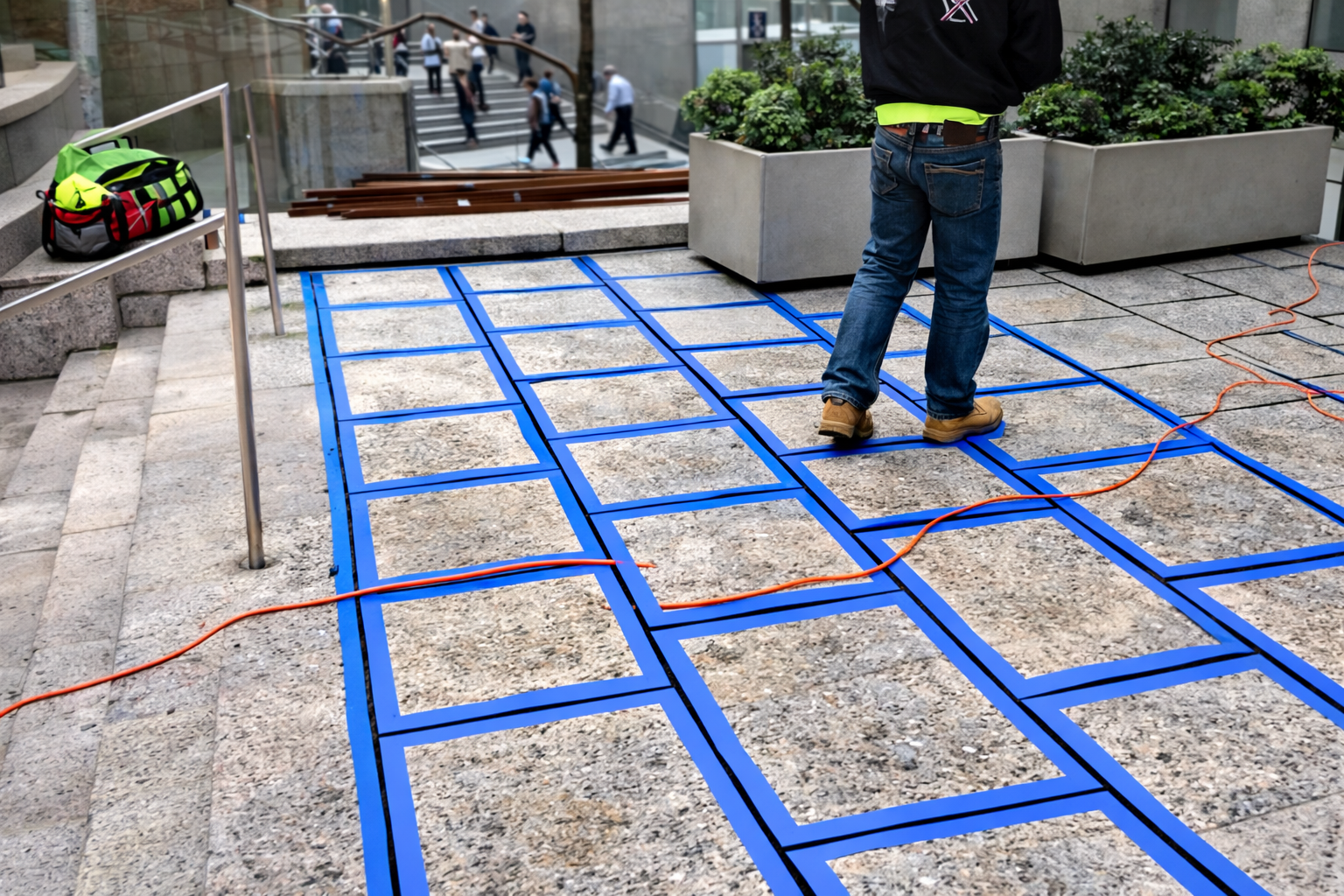
Facades move. Thermal expansion, settlement, and wind load all cause a building’s exterior to shift, and expansion joints absorb that movement without cracking the surrounding material. When the sealant fails, which it eventually does, water finds a direct path into the wall assembly behind it.
- Window perimeters and curtain wall joints are common failure points
- Masonry control joints need flexible, compatible sealants, not just any caulk
- Sealant replacement only works long-term when the joint is properly prepared first
Traffic-Bearing Membranes: Protecting Commercial Decks and Parking Structures
Traffic-bearing membranes deserve their own section: they solve a problem regular membranes can’t, protecting concrete that also carries ongoing vehicle or foot traffic. We’ve written a full technical breakdown in our traffic-bearing membrane systems guide, but here’s the short version for NYC property owners comparing options.
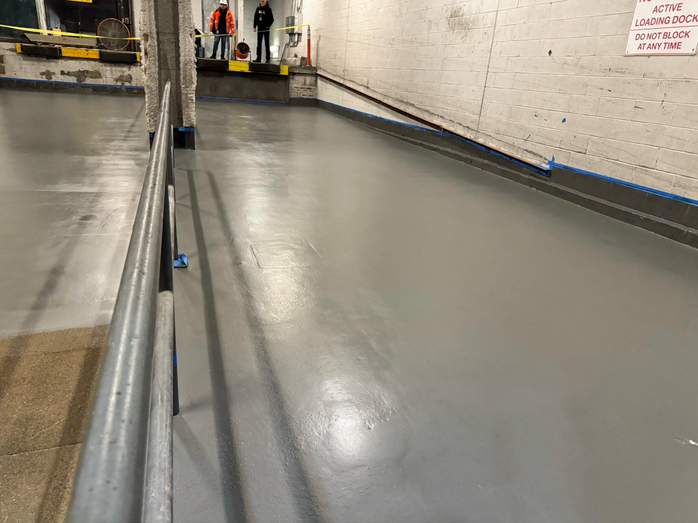
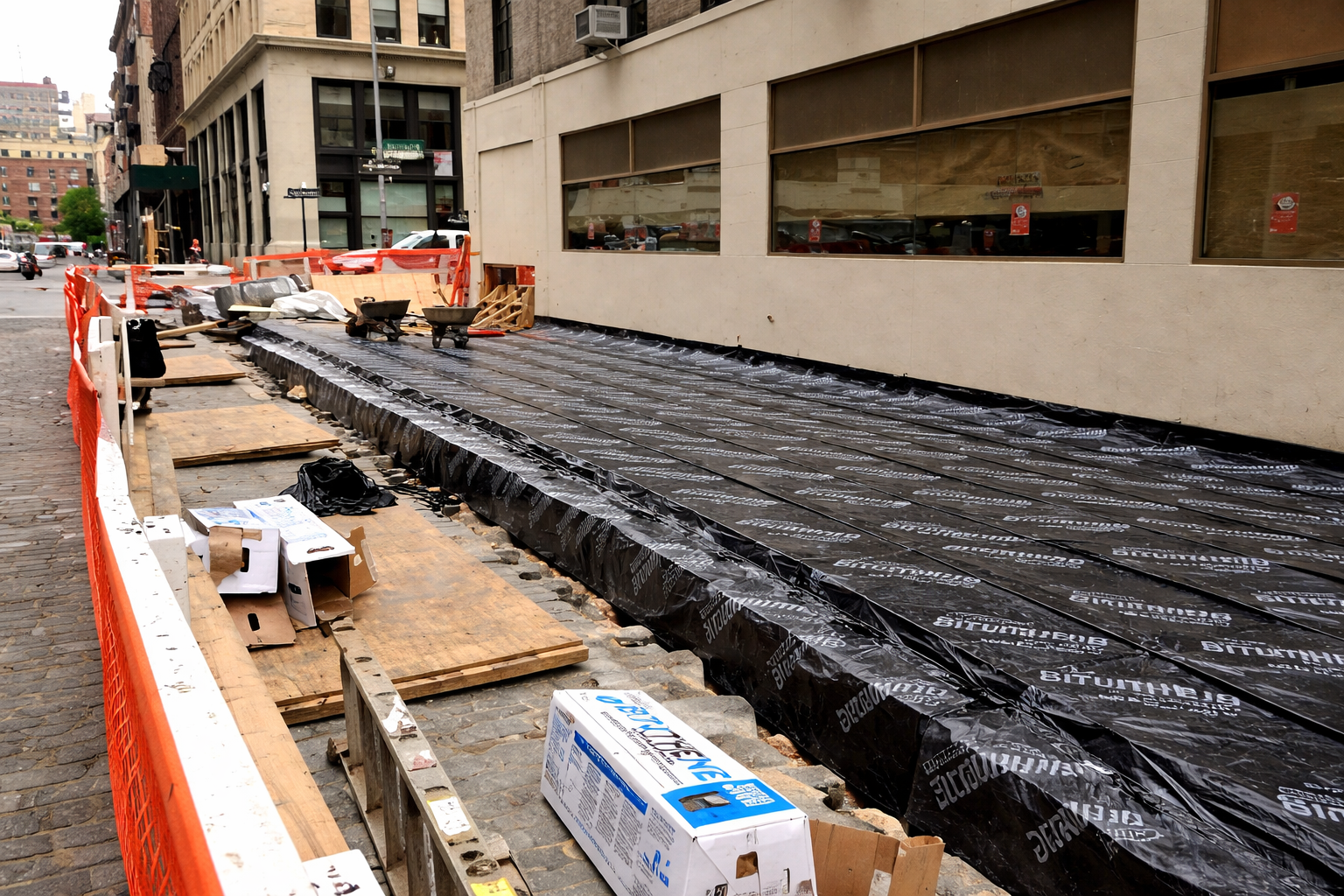
This is actual Malatesta Paladino project work: traffic-bearing membrane installation at 15 Central Park West. A traffic-bearing membrane is a multi-layer system, primer, base, reinforcement, wear course, and topcoat, engineered to take direct wear while keeping water out of the structure beneath it.
Vehicular vs. Pedestrian Traffic-Bearing Membranes
- Vehicular-rated systems need thicker wear courses and higher abrasion resistance for tire traffic and turning stress
- Pedestrian-rated systems prioritize slip resistance and finish appearance over abrasion resistance
- Using a pedestrian-rated system on a vehicular surface is one of the most common causes of early failure
Where Are Traffic-Bearing Membranes Used?
- Parking garages and parking decks
- Plaza decks over occupied space
- Podium decks above retail or lobby areas
- Rooftop terraces with regular foot traffic
- Pedestrian walkways and entry areas
Signs That a Traffic-Bearing Membrane Needs Replacement
- Visible cracking or blistering in the wear surface
- Ponding water that no longer drains properly
- Exposed aggregate or bare spots where the topcoat has worn through
- Rust staining bleeding up through the surface, a sign of corrosion underneath
Benefits of Professional Traffic-Bearing Membrane Installation
A traffic-bearing membrane is only as good as its installation. Surface prep, primer compatibility, and correct thickness at every layer determine whether it lasts 15 years or fails within two, which is why this isn’t a job for a general painting crew.
Ask any contractor bidding traffic-bearing membrane work whether the system is rated for vehicular or pedestrian traffic. Installing a pedestrian-rated system on a driving surface is one of the most common, and most expensive, mistakes we see on existing garages.
Common Signs Your NYC Commercial Building Needs Waterproofing
Most waterproofing failures give warning signs long before they become emergencies. The problem is that those signs often look minor in isolation, a small stain, a slightly damp wall, until they’re looked at together as part of a pattern.
- Water stains on ceilings and walls, especially below grade or near plaza decks
- Efflorescence, the white chalky residue left behind as water evaporates out of concrete and masonry
- Cracked or deteriorated caulking around windows, joints, and penetrations
- Standing water on parking decks or plaza surfaces that doesn’t drain
- Rust stains and spalling concrete, both signs that water has already reached embedded steel
- Water infiltration in basements or below-grade mechanical rooms
- Deteriorating expansion joints that have gone soft, cracked, or come loose
Don’t wait for a visible leak before scheduling an inspection. Efflorescence and rust staining are both signs that water has already reached the inside of the structure, well before anything looks like an active leak.
How to Choose the Right Commercial Waterproofing System
Picking a waterproofing system isn’t about choosing the newest product on the market, it’s about matching the system to that surface’s conditions. A lot of commercial projects go wrong here: a system gets specified on cost or familiarity rather than actual exposure and traffic.
Identify the Source and Direction of Water Infiltration
Water rarely shows up where it actually entered the structure. Tracing the real entry point, rather than patching where the stain appears, is the first step in any waterproofing assessment.
Assess the Building's Structural Condition
Waterproofing over damaged concrete is a short-term fix at best. The substrate needs to be structurally sound before any membrane goes on, or the new system fails along the same lines as the old damage.
Consider Hydrostatic Pressure and Environmental Exposure
- Below-grade walls under constant groundwater pressure need continuous, positive-side systems where possible
- Exposed decks need UV-stable, weather-resistant membranes
- High-traffic surfaces need abrasion-resistant, traffic-bearing systems
Select the Right Waterproofing Membrane
Evaluate Drainage and Surface Preparation Requirements
A membrane performs only as well as the surface and drainage underneath it. Poor drainage concentrates water exactly where the membrane is under the most stress, and inadequate prep is a leading cause of adhesion failure.
Consider Building Occupancy and Maintenance Requirements
An occupied commercial building has scheduling and access constraints a vacant structure doesn’t, so the waterproofing plan needs to work around tenants and daily operations, not against them.
| Building Application | Waterproofing Considerations |
| Foundation walls | Below-grade protection and groundwater pressure |
| Plaza decks | Membrane continuity, drainage, and a protective wear course |
| Parking garages | Vehicular traffic and abrasion resistance |
| Rooftop terraces | Weather exposure and pedestrian use |
| Sidewalk vaults | Subsurface protection and structural condition |
| Facade joints | Flexible sealants matched to building movement |
Commercial Waterproofing Process: From Inspection to Installation
Every waterproofing project follows roughly the same sequence, though scope varies by building, system, and whether it’s new construction or an existing-building repair.
- Step 1: Initial site inspection to document existing conditions and water infiltration patterns
- Step 2: Identify water entry points and any related structural issues
- Step 3: Surface preparation and repair of damaged concrete or masonry
- Step 4: Waterproofing system selection based on substrate, exposure, and traffic
- Step 5: Membrane installation and sealing of all joints and penetrations
- Step 6: Quality checks and final inspection before the area returns to service
- Step 7: Ongoing maintenance and periodic assessment to catch wear before it becomes a failure
How Much Does Commercial Waterproofing Cost in NYC?
There’s no honest flat number here, and any contractor quoting one without seeing the building is guessing. Project cost depends on factors specific to that building and scope.
- Total waterproofing area
- Type of membrane and application method
- Existing concrete damage requiring repair before waterproofing can begin
- Excavation or demolition requirements
- Site accessibility and equipment needs
- Drainage improvements required alongside the membrane work
- Building occupancy and construction scheduling constraints
- Extent of required surface repairs
New Construction vs. Waterproofing Existing Buildings
New construction allows waterproofing to be designed in from the start, with full access before anything is backfilled. Existing buildings are a different challenge, often requiring work around occupied space and limited access.
Waterproofing Repair vs. Complete Membrane Replacement
Not every waterproofing failure means tearing out the entire system. Localized repairs can extend a membrane’s life if the rest is still sound, but widespread failure or age usually points toward full replacement.
Why Early Waterproofing Maintenance Can Reduce Long-Term Repair Costs
Addressing a worn sealant joint early is dramatically cheaper than waiting for water to reach the reinforcing steel. Once corrosion starts, the repair jumps from a maintenance item to a structural one.
Once chloride-laden water reaches reinforcing steel, the resulting corrosion expands and cracks the surrounding concrete from the inside out, turning a sealant repair into a structural concrete repair.
Why Choose Malatesta Paladino for Commercial Waterproofing in NYC?
Malatesta Paladino has protected NYC commercial properties for over 40 years, operating since 1985, with direct expertise in concrete and masonry restoration, waterproofing, caulking, and traffic-bearing membranes. We work on occupied buildings across NYC, so every project is planned around tenants and daily business.
Proven Experience on Manhattan Commercial Projects
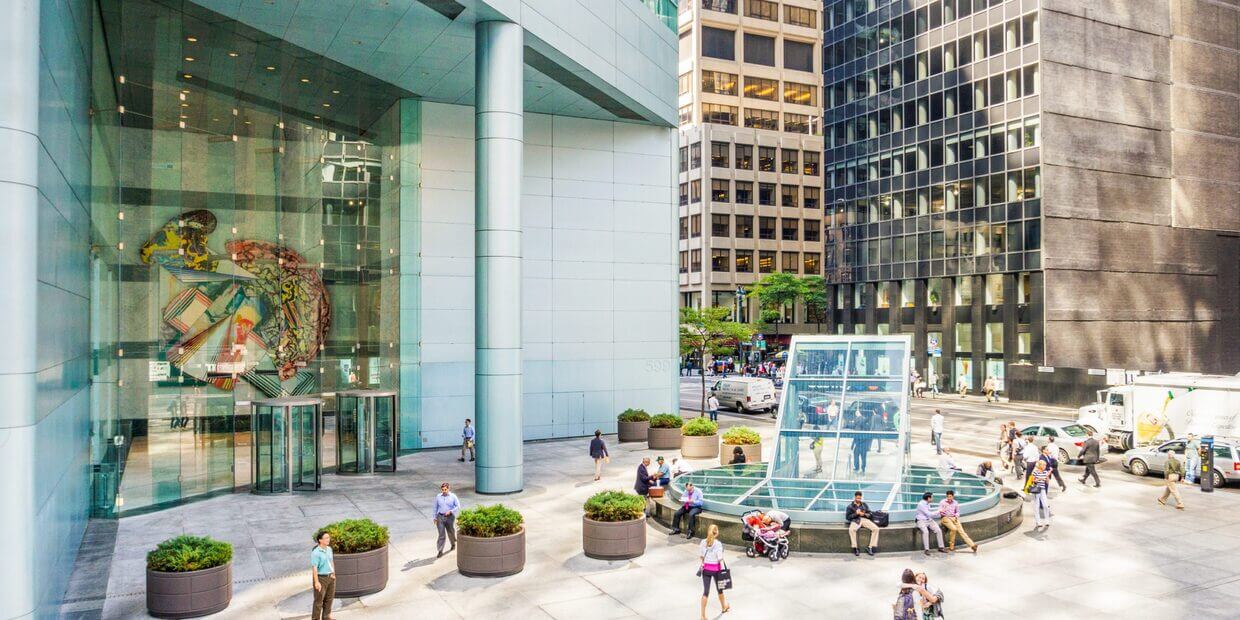
At 599 Lexington Avenue for BXP, our team handled stone replacement as part of a plaza waterproofing project, coordinating structural stone work with the membrane underneath it. At 15 Central Park West, we installed traffic-bearing membrane systems on parking deck surfaces. You can see more of our completed work on our projects gallery.
A Complete Approach to Commercial Building Protection
Waterproofing rarely stands alone on a commercial building. It connects directly to facade restoration, concrete and masonry repair, parking garage restoration, and structural steel protection. See also our guides on sidewalk violations in NYC, fireproofing requirements, and our pre-winter exterior repair checklist. One team, rather than several disconnected vendors, keeps a building’s exterior working as one coordinated system.
What is commercial waterproofing?
Commercial waterproofing is the system of materials and methods used to prevent water infiltration into a commercial building’s structure, including foundations, decks, parking structures, and facades.
How long does commercial waterproofing last?
Service life depends on the system, installation quality, exposure, and maintenance, but a properly installed system can be expected to perform for well over a decade before needing significant repair.
What is the best waterproofing system for a commercial building?
There isn’t one universal answer. The right system depends on whether the surface is below-grade, exposed to weather, or carrying traffic, which is why an assessment comes before system selection.
How much does commercial waterproofing cost in NYC?
Cost depends on area, substrate condition, system, access, and whether it’s new construction or an existing-building repair. An accurate number requires an on-site evaluation.
What is the difference between waterproofing and damp-proofing?
Damp-proofing resists moisture vapor but isn’t designed to hold back standing water or hydrostatic pressure. Waterproofing is a more robust system built to resist water under pressure.
What is the difference between sheet-applied and liquid-applied waterproofing?
Sheet membranes are factory-manufactured rolls applied to the substrate, while liquid-applied systems cure into a seamless membrane on site. Liquid systems handle complex geometry better; sheet systems offer more consistent thickness.
How does hydrostatic pressure affect commercial foundations?
Groundwater pushes constantly against below-grade walls and slabs, and any gap in the waterproofing lets that pressure force water through. This is why below-grade systems need continuous coverage, not spot treatment.
What is a traffic-bearing waterproofing membrane?
A traffic-bearing membrane is a multi-layer system engineered to withstand pedestrian or vehicular traffic while protecting the concrete underneath from water intrusion.
How often should commercial waterproofing systems be inspected?
Most systems benefit from at least an annual inspection, with closer attention to high-wear areas like parking ramps, drains, and expansion joints.
Can waterproofing be installed in an occupied commercial building?
Yes, in most cases. It requires careful scheduling and coordination with building operations, but occupied-building waterproofing work is routine for an experienced commercial contractor.
When should a commercial parking garage waterproofing membrane be replaced?
Visible cracking, blistering, exposed aggregate, rust staining, or standing water that no longer drains are signs a parking garage membrane needs evaluation.
How do I find a commercial waterproofing contractor in NYC?
Look for a contractor with direct commercial project experience, familiarity with NYC building conditions, and the ability to coordinate waterproofing with related structural and facade work.
Protect Your NYC Commercial Property with Professional Waterproofing
Water infiltration doesn’t stay a small problem for long in a NYC commercial building. Addressing failing membranes, worn sealants, and below-grade vulnerabilities early protects both the structure and your budget. Malatesta Paladino provides commercial waterproofing services across Manhattan and the wider NYC area, with direct experience on buildings like 599 Lexington Avenue and 15 Central Park West.