

How to Remove a Sidewalk Violation in NYC: A Step-by-Step Guide for Property Owners
If a Notice of Violation just landed in your mailbox from the NYC Department of Transportation, take a breath first. It’s not a fine, and it’s a checklist you can work through. The part that trips most owners up: fixing the concrete and clearing the violation are two separate steps, not one.
At Malatesta Paladino, we’ve handled concrete, masonry, and sidewalk work for commercial properties across New York City since 1985. Here’s the full path from notice to dismissal, laid out the way we’d walk a client through it on site.
QUICK ANSWER
- Review the Notice of Violation and confirm the cited defects
- Decide whether to repair or dispute
- Hire a contractor who knows DOT specifications
- Obtain a sidewalk construction permit
- Complete the repair to DOT spec
- Prepare the site and request a dismissal inspection through 311
- Pass DOT’s inspection
- Confirm the violation is officially cleared
What Is a Sidewalk Violation in NYC?
A sidewalk violation is a notice from NYC DOT stating that an inspector found a defect in the sidewalk next to your property. It gets filed with the County Clerk and stays on record until the Clerk receives official word that the repair is complete.
📌 FACT There is no fine attached to a sidewalk violation itself. It’s a notice, not a bill. You only get billed if DOT ends up doing the repair work for you.

Why Does DOT Issue Sidewalk Violations?
- To get defective sidewalks fixed before someone gets hurt
- Inspections often target blocks with reported injuries or open complaints
- Violations show up in every borough, on every kind of property
Who's Responsible for Sidewalk Repairs?
- Property owners must install, reconstruct, and repair the sidewalk next to their building
- Responsibility extends to corner ramps on intersection properties
- Owners are also responsible for keeping the sidewalk clear and clean
- Commercial properties add complexity: storefronts, loading zones, vaults, and heavy foot traffic all change how a repair gets planned
What If Tree Roots Caused the Damage?
- NYC Parks runs a Trees & Sidewalks Program for sidewalk damage caused by root growth
- Funding is limited, and the program mainly prioritizes owner-occupied one-, two-, and three-family homes
- Commercial buildings typically need to handle root-related repairs privately, still meeting DOT’s spec
What Sidewalk Problems Trigger a DOT Violation?
| Defect | What It Looks Like | Why It’s Cited |
| Missing flag | A section of sidewalk is gone or was never built | Leaves an unsafe gap |
| Cracked flag | Full-depth crack, joint to joint, ¼ inch or wider | Pieces can loosen or break free |
| Undermined flag | Void beneath the concrete, or a flag that rocks | Risk of sudden shifting or collapse |
| Trip hazard | Vertical difference of ½ inch or more between flags | Direct fall risk |
| Improper slope | Flags that pool water instead of draining to the curb | Ice hazards, standing water |
| Hardware defect | Covers not flush within ½ inch, or unsafe cellar doors | Trip and fall risk |
| Structural defect | Crack running joint to joint on a connected flag | Signals a wider repair area |
| Patchwork | Partial-depth repairs, or asphalt instead of concrete | Doesn’t meet DOT spec |
NUMBER: ½ INCH A vertical difference of ½ inch or more between two adjacent sidewalk flags is enough, on its own, to qualify as a trip hazard under NYC’s rules.
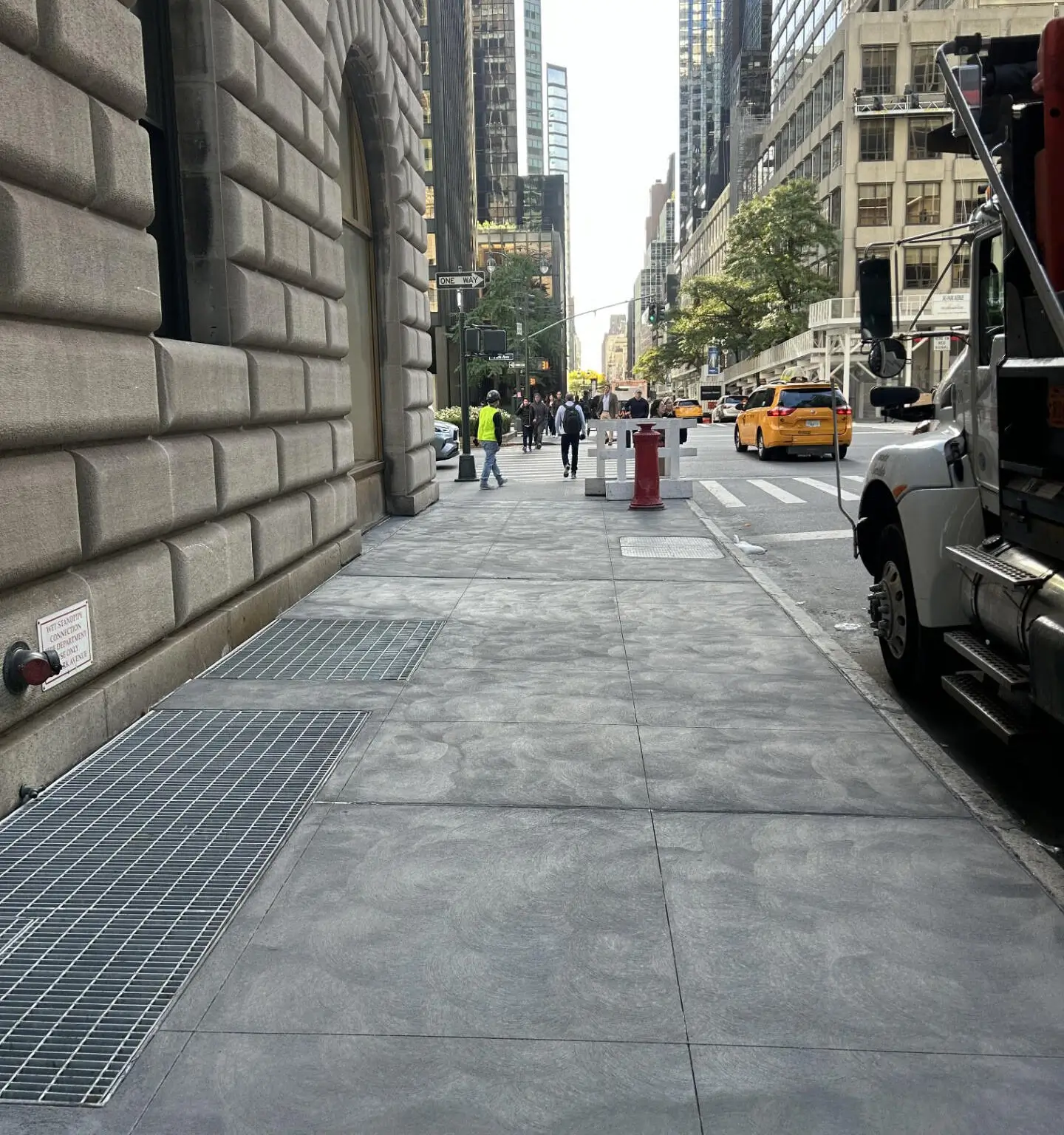
Step 1: Read Your Notice of Violation Carefully
Before calling anyone, sit down with the notice and the attached Preliminary Inspection Report (PIR).
Check on the notice:
- Violation number
- Property address
- Block and lot
- Numbered flags cited
- Type of defect listed for each flag
Then compare it against the real sidewalk:
- Sidewalk width and dimensions
- Trees, utility caps, cellar doors
- Any unique features that should match the PIR
PRO TIP: Violations occasionally land on the wrong property. If the PIR doesn’t match what’s actually outside your door, call 311 and ask for a “Sidewalk Violation Search” before doing anything else.
Step 2: Decide Whether to Repair or Dispute
| Situation | What to Do |
| Defects clearly match the notice | Move straight into hiring a contractor |
| You disagree with the cited defects | Request a re-inspection within 75 days |
| Damage looks tree-related | Contact NYC Parks’ Trees & Sidewalks Program |
| Property details look wrong | Call 311 for a Sidewalk Violation Search |
| Multiple defects are listed | Have the whole property reviewed, not just the obvious spot |
- Call 311 and ask for “Dispute New Sidewalk Violation – Re-Inspection Request”
- A different inspector, without access to the original PIR, re-checks the sidewalk
- You’ll get at least 5 days’ notice by mail before the re-inspection
Step 3: Understand the 75-Day Repair Window
75 DAYS That’s how long you have from receiving the violation to start private repairs, not finish them entirely.
Key rules to know:
- The clock starts on the date you receive the notice, or the posting date if it wasn’t sent by certified mail
- A permit does not extend the 75-day window
- If work doesn’t start in time, DOT can perform the repair (or hire a contractor) and bill you afterward
- Winter violations still run on the same clock; schedule a contractor to begin as soon as weather allows
PRO TIP Don’t wait until week 70 to start calling contractors. Scheduling, material lead times, and permit processing eat into that window fast.
Step 4: Hire a Contractor Who Knows DOT Specifications
DOT recommends hiring a contractor familiar with the sidewalk repair specifications in Title 34 of the Rules of the City of New York, and confirming the contractor is properly licensed.
What a commercial repair typically requires:
- Coordinating around active storefronts and building entrances
- Protecting pedestrian traffic during business hours
- Working around loading docks, vaults, and utility infrastructure
- Managing permits and inspection scheduling
- Documenting the work for the property’s records
At Malatesta Paladino, this falls under our Sidewalks, Curbs & Roadways service. For sidewalks built over a vault or basement, our Vaulted Sidewalks & Structural Reinforcing team handles the added structural work.
Step 5: Pull the Sidewalk Construction Permit
- Private sidewalk repair requires a Sidewalk Construction Permit from DOT
- Doing the work yourself still requires the permit and full compliance with DOT specs
- Most commercial owners let their contractor manage this step
Step 6: Complete the Repair to DOT Spec
What needs to happen:
- Every numbered flag on the PIR gets replaced
- Any cited defects get corrected
- Free-standing flags (flags that come loose once adjacent defective flags are pulled) should also be replaced, even if not individually marked
Typical repair sequence:
- Set up the work area and protect pedestrians and neighboring property
- Remove the defective concrete flags
- Address the subgrade, especially if water or roots caused the failure
- Prepare the base for new concrete
- Install expansion joints at the required spacing
- Pour and finish the new concrete
- Restore the surrounding area and clean the site

⚠️ DON’T MAKE THIS MISTAKE Pouring fresh concrete over a bad subgrade, a drainage problem, or a nearby vault issue is a short-term fix. Our Concrete and Masonry team checks for this before calling a repair finished, so the property doesn’t land back on DOT’s radar in a few years.
Step 7: Prepare for the Dismissal Inspection
Checklist before you request the inspection:
- Sidewalk permit obtained
- All cited defects removed and corrected
- Expansion joints installed, sealed, and level with the sidewalk
- Joints spaced at minimum every 20 linear feet, at property lines, and where curb meets sidewalk
- Detectable warning surfaces (truncated domes) installed on any pedestrian ramps in the work
- Entire sidewalk clear and visible, no cars, equipment, or debris in the way
Step 8: Request the Sidewalk Violation Dismissal
Have this ready when you call:
- Sidewalk permit number
- Property address
- Block and lot
- Notice of Violation number
- Contact information or email
⚠️ DON’T MAKE THIS MISTAKE Finishing the concrete does not close the violation on its own. You still need to request a dismissal inspection through NYC 311.
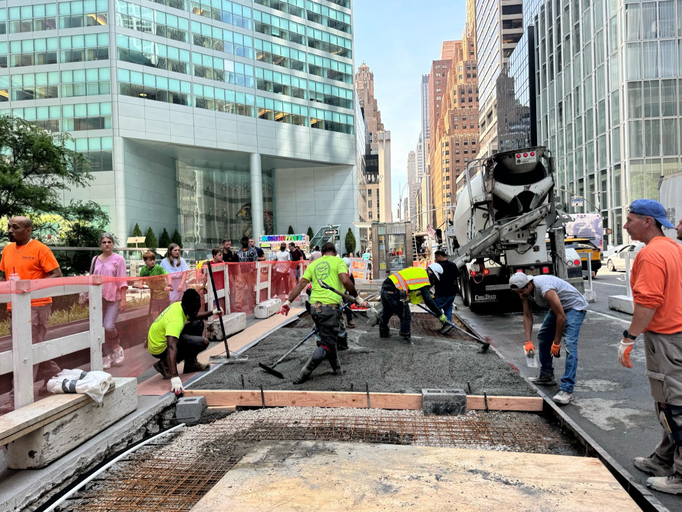
Step 9: Pass the DOT Inspection
What the inspector checks:
- Cited defects are gone
- Joints are properly placed and sealed
- Surface drains correctly, no pooling
- Site was accessible for review
If it doesn’t pass:
- Correct the flagged issue
- Request another inspection
- Working with a contractor who already knows DOT’s spec reduces the odds of a repeat trip
Step 10: Confirm the Violation Is Cleared
- DOT notifies the County Clerk once the inspection is approved
- The violation is removed from your property record
- Keep your permit, contractor documentation, and DOT correspondence with your permanent property files
💡 PRO TIP If the property changes hands or gets refinanced later, that paperwork can save weeks of back-and-forth.
The Full Process at a Glance
Step | Action | Who’s Involved |
1 | Review the notice and PIR | Property owner |
2 | Verify or dispute the cited defects | Owner, DOT |
3 | Track the 75-day start deadline | Property owner |
4 | Hire a licensed contractor | Property owner |
5 | Obtain the sidewalk construction permit | Contractor, DOT |
6 | Complete the repair to spec | Contractor |
7 | Prepare the site for inspection | Contractor, owner |
8 | Request the dismissal inspection | Owner, contractor, 311 |
9 | Pass DOT’s dismissal inspection | DOT |
10 | Confirm the violation is cleared | Owner |
Common Mistakes That Keep a Violation Open
Don’t let the report sit in an inbox.
Use this process:
Waiting too long to start.
The 75-day clock runs from the date you receive the notice, not from when you call a contractor.
Fixing the obvious crack and ignoring the rest.
DOT wants every numbered flag on the PIR addressed.
Starting work without a permit.
Repairs without a Sidewalk Construction Permit don't meet DOT's requirements, even if the concrete looks fine.
Assuming the repair automatically closes the file.
Someone still has to request the dismissal inspection.
Skipping the tree-root conversation.
Loop in NYC Parks early if roots are involved, not after the concrete is already poured.
Losing the paperwork.
Permits, inspection results, and dismissal confirmations belong in a permanent file, not a drawer.
Can You Remove a Sidewalk Violation Yourself?
Yes, technically:
- DOT allows owners to do the repair personally
- You must obtain the permit and follow DOT specifications exactly
- Realistic for a small residential sidewalk with a hands-on owner
For a commercial property, it’s a different calculation:
- Managing pedestrian safety during active business hours
- Coordinating around a storefront or lobby entrance
- Navigating permitting and inspection that has to go right the first time
Most commercial owners find it faster, in the end, to bring in a contractor who’s already run this process dozens of times.
Why Commercial Owners Work With Malatesta Paladino
40+ Years of NYC Experience
Concrete and masonry contractor in NYC since 1985
Comprehensive Repair Capabilities
Sidewalk, curb, and roadway work has been part of our business from the start
Handles Documentations
We manage permits, inspections, and compliance documentation as part of the job
Proof point: we’re currently performing new concrete sidewalk installation at 1 World Trade Center, carried out to NYC DOT standards.

FAQ: NYC Sidewalk Violations
How do I remove a sidewalk violation in NYC?
Repair the cited defects to DOT specifications under a proper permit, then call 311 to request a dismissal inspection. DOT removes the violation once an inspector confirms the repair.
How long do I have to start repairs after receiving a violation? 7
5 days from the date you receive the Notice of Violation. If it wasn’t sent by certified mail, the 75 days starts from the posting date on the property.
Is a sidewalk violation a fine?
No. It’s a notice, not a monetary penalty. You’re only billed if DOT ends up performing the repair itself.
Can I dispute a sidewalk violation?
Yes. Call 311 within 75 days and request a re-inspection if you believe the cited defects are inaccurate.
Do I need a permit to repair my sidewalk?
Yes, whether you hire a contractor or do the work yourself.
Does repairing the sidewalk automatically clear the violation?
No. You still need to request a dismissal inspection through 311.
What happens if I don't repair my sidewalk within 75 days?
DOT can perform the work, or hire a contractor to do it, and bill you afterward.
What if tree roots caused the sidewalk damage?
Contact NYC Parks about the Trees & Sidewalks Program. Eligibility mainly covers owner-occupied one-, two-, and three-family homes; commercial properties usually address root damage as part of a private repair.
Can a contractor handle the whole process for me?
Yes. An experienced contractor can manage the permit, complete the repair, and coordinate the dismissal inspection on the owner’s behalf.
How do I confirm my violation has actually been cleared?
DOT notifies the County Clerk once the dismissal inspection passes. Keep your permit and inspection documentation for your records.
Have a sidewalk violation sitting on a commercial property?
Contact Malatesta Paladino and we’ll walk the site, explain what DOT is asking for, and manage the repair and inspection process from permit to dismissal.